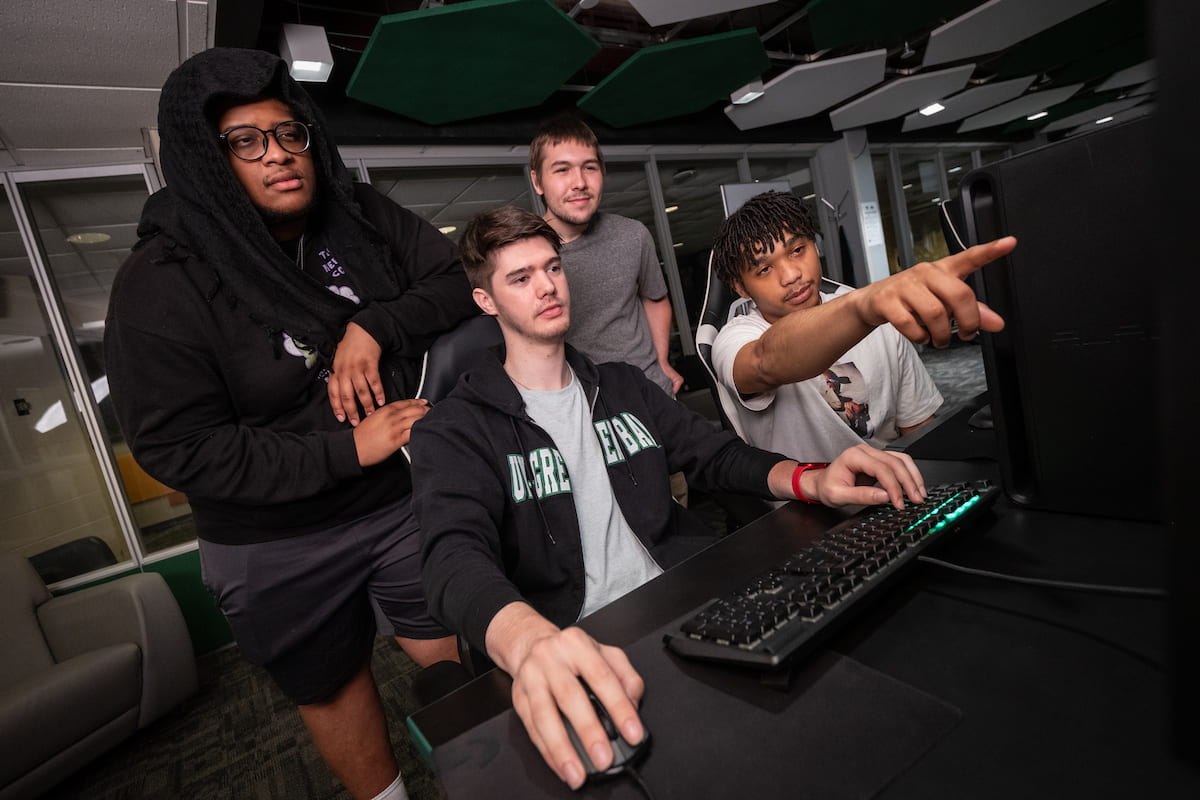
Engineering is more than high-level tinkering—it’s the art of imagining what doesn’t yet exist and building it into reality. It’s a bold blend of imagination and precision, where ideas leap off the page and into the world. No longer limited to mechanics or chemicals, today’s ever-expanding engineering universe spans everything from aerospace to biomedical—and at the heart of it all: software.
At UW-Green Bay, a new generation of engineers is emerging, equipped not only with coding skills but with the mindset to lead in an era defined by artificial intelligence and rapid innovation.
Software engineering stands out not just for its explosive growth but for its transformative career potential. According to the U.S. Bureau of Labor Statistics, employment in software engineering is projected to grow 17% from 2023 to 2033, with a median national annual salary of $133,080 and a starting salary around $71,280. But beyond the impressive earning stats, software engineers are uniquely positioned to enhance, support and revolutionize nearly every other professional pursuit—especially in the age of artificial intelligence. It’s a launchpad for innovation across industries, interests and ambitions.
Software engineering is also no longer just a technical discipline—it’s a creative, collaborative, and future-focused field that’s reshaping how we live, work and learn. At UW-Green Bay, a new generation of engineers is emerging, equipped not only with coding skills but with the mindset to lead in an era defined by artificial intelligence and rapid innovation.
Engineers for What’s Next

In the case of Ethan Christman, a UW-Green Bay senior scheduled to be among the first graduates from the Software Engineering program, his interest began not through the classic route of computer video games, but an undiscovered talent for programming.
“I took a few computer courses in high school and liked programming, so I decided to stick with that,” he recalls. “I got like 108% in the course and loved every second.”
When Christman arrived at UW-Green Bay in 2022, the primary option for a software-based major was computer science—but Christman was drawn to something more applied. Software engineering builds on the same core principles as computer science, but focuses on designing, building and maintaining the systems that power our digital lives.
The average American now spends nearly eight hours a day connected to a smart device—all driven by software. With the rise of generative artificial intelligence (GAI), that digital evolution has become a full-blown revolution. It’s a pivotal moment; software engineers will lead the application of structured, professional practices to ensure that software is not only functional, but also innovative, scalable and updatable in this rapidly changing industry.
Software engineering is attracting soon-to-be high school seniors, and also career changers and lifelong learners who see its growing potential. For returning college graduate Calvin Berndt, the allure of artificial intelligence motivated his career-pivot to software engineering.
Already possessing a degree and career history in biochemistry, Berndt is now a self-described “super-super senior,” pursuing a second bachelor’s degree at UW-Green Bay in Software Engineering. “What really pushed me into software engineering was the breakneck speed of AI development,” he said. “AI is going to change everything over the next decade, and I want to be part of that change.”
Collaborating at the Cutting Edge

With nearly a decade of work experience, Berndt’s career path has taken him from research labs—where he once considered pursuing a Ph.D. in biochemistry—to the factory floor, gaining hands-on experience in both industrial maintenance and food safety. When it came to software, Berndt felt a sense of urgency. “It was kind of a now-or-never moment,” he said. “I realized if I didn’t jump into this field soon, I might miss my chance.”
Both Christman and Berndt found that personalized guidance from faculty and advisors was key to shaping a path that fit their unique goals. Christman credits Professor Omar Meqdadi, assistant professor of Computer Science/Cybersecurity, as a key influencer in his decision to pursue software engineering as part of his computer science studies. He also credits his academic advisor for helping him stay on track to graduate in four years, even as he refined his academic focus.
Figuring out “what works” is central to UW-Green Bay’s approach to teaching software engineering. “If you’ve ever wondered how YouTube works, or what powers the systems behind your favorite apps, software engineering might be your path”, explains Meqdadi. “We teach the same principles used by developers at YouTube, Facebook, and Google. But it’s not just about theory—it’s about building real solutions that work in the real world.”
For Christman, the software engineering program’s hands-on, practical approach made all the difference. “It helped me focus on best practices—what actually works and not just ‘in theory.’”
Unique to UW-Green Bay’s program, software engineering focuses on working as a team —students don’t just learn to code, they learn to collaborate. “We work as a team in classes where everyone has a voice and is offering ideas,” says Christman.

That spirit of cooperation is matched by a hands-on approach to learning. “We focus on practical experience alongside theory,” explains Meqdadi. “Through projects, labs and teamwork, students learn how to apply software development principles just like professionals do in the industry.”
“When our students graduate, they don’t see a gap between what they learned and what they’ll face in the real world.”
UW-Green Bay Assistant Professor Omar Meqdadi
With close partnerships across local and regional businesses, students gain experience that’s both practical and future-focused—especially as they adapt to emerging technologies like generative AI.
“When our students graduate,” Meqdadi adds, “they don’t see a gap between what they learned and what they’ll face in the real world.”
Motivation through Innovation
For a non-traditional student entering this dizzying pace of innovations, the future is now. Berndt wasted no time diving into his new field. Within two months of enrolling, he was working with Associate Professor Iftekhar Anam and Assistant Professor Sayeda Farzana Aktar on a research project developing software aimed at improving ADA accessibility in physical classrooms. “They’ve been incredible mentors,” he said. “I’ve been working with them ever since.”
That early research experience led to an internship—and eventually a job—at Anser, a business support center in Ashwaubenon. There, Berndt is using AI to streamline quality assurance. “We use automatic speech recognition to transcribe customer service calls,” he explained. “Then we run Python scripts—small programs that automate tasks—to evaluate whether agents are meeting about 25 or 26 different quality standards.” These agents are customer service representatives who handle calls and support tasks for a variety of client businesses. The system doesn’t replace human evaluators, he added, but it makes their work faster and more consistent.
Berndt is also returning to his research roots—only now through the lens of software engineering. Over the past semester, Berndt has presented at conferences in Madison and Chicago. “We just secured a grant to continue our work,” he said. “I’ll be leading the next phase of the project, including hiring new student researchers.”

Students like Christman and Berndt aren’t just chasing job security—they’re driven by curiosity, creativity and the desire to solve real problems. They thrive in an environment of constant discovery, where emerging technologies like generative AI aren’t seen as threats, but as tools to think bigger and build smarter. “AI is part of the software engineering process,” says Meqdadi. “It streamlines the routine tasks so students can focus on what really matters—designing, solving, innovating.”
UW-Green Bay Software Engineering students learn to be the ones guiding the technology, not the other way around. “You will be the instructor of the AI,” Meqdadi emphasizes. “It won’t think for you—you’ll think about the problem, and AI will help you solve it faster.” With new emphases in AI and machine learning being added to the curriculum, the program is evolving alongside the industry. And as Meqdadi reminds us, “There’s no need to fear AI. It’s part of the game—and we’re teaching students how to play it well.”
Written by Michael Shaw
Photos by Dan Moore, University Photographer
Link to original story: https://news.uwgb.edu/featured/08/20/software-sparks/